[ Feature ]
Form : Shinogi-zukuri construction, iori-mune, broad blade width, thick layer of grain, slightly shallow curvature, forming a large o-kissaki tip.
Nakago : Raw tang, file marks in diagonal lines, with decorative filing, tip with a chestnut-shaped edge, one mekugi hole.
Jigane : The jigane (base metal) exhibits a well-grained ko-itame-hada pattern and ji-nie.
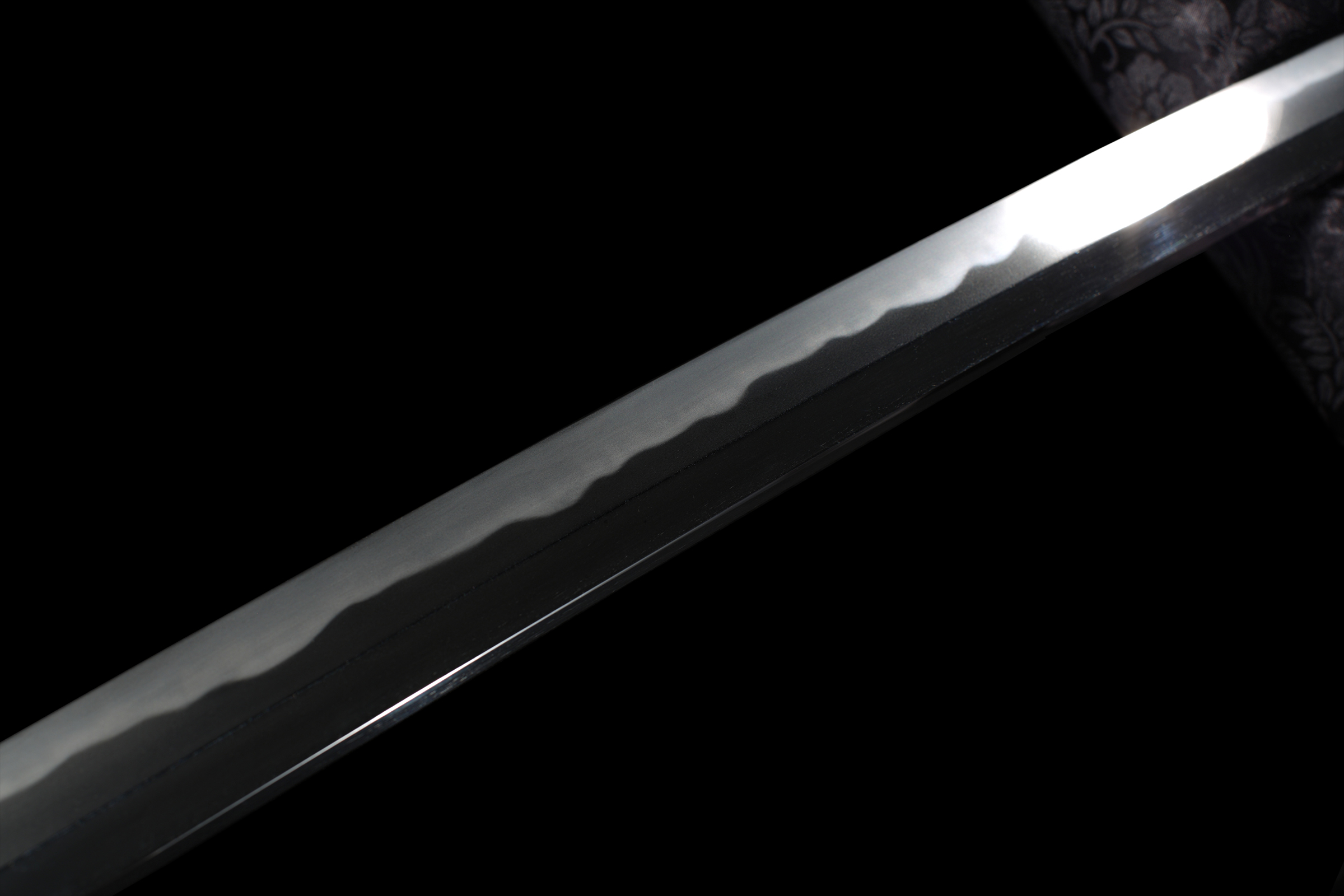
Hamon : The hamon is mixed with cho-ji midare, well-defined with ko-nie.
Boushi : The boshi is a turbulance with small raound, returning with a pointed tip.
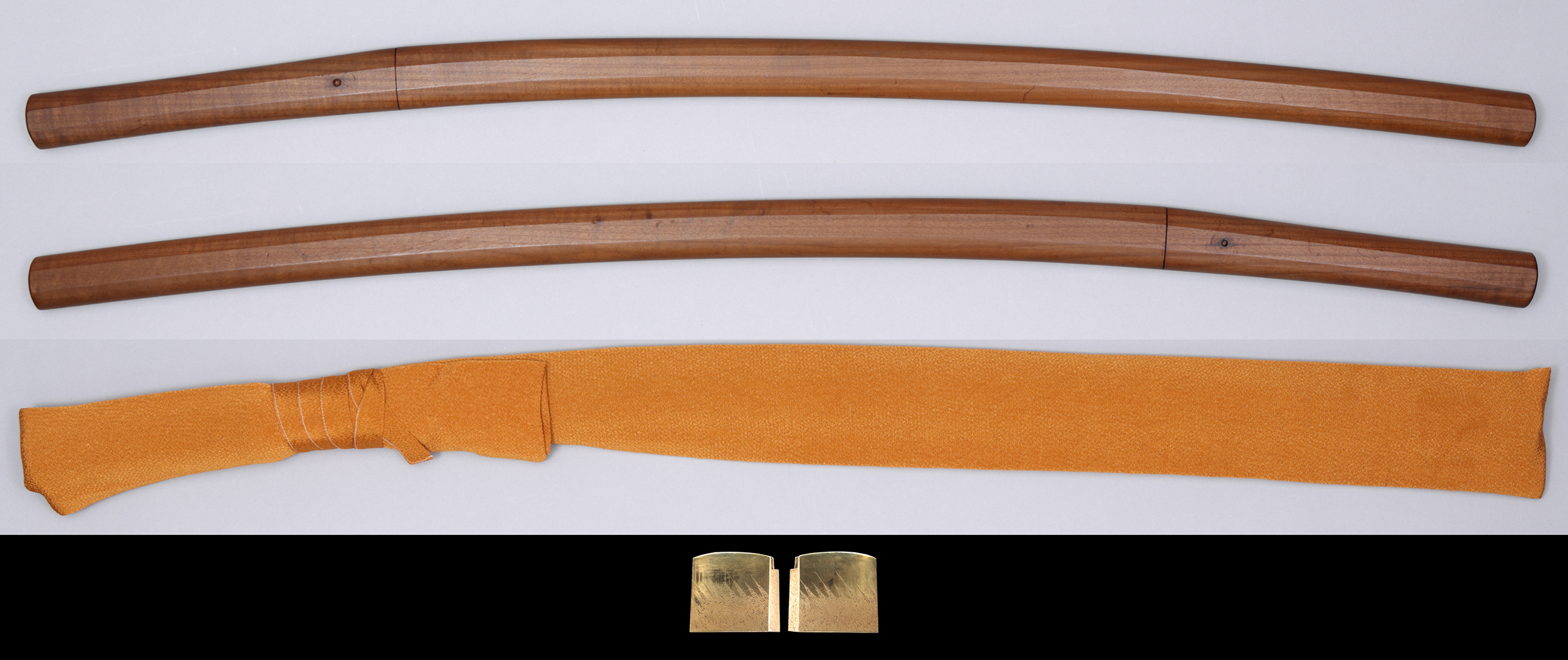
[ Highlight ] Hosokawa Masamori, also known as Sennosuke, was the eldest son of Hosokawa Masayoshi and a clan craftsman of the Tsuyama domain in Mimasaka Province. He studied under his father, the second Masayoshi, who had travelled from Kanuma in Shimotsuke Province to Edo to learn under Suishinshi Masahide. Masamori followed the created swords theory of Masahide practised by his father and specialised in the Bizen tradition. His signature includes: “Made by Masamori, a retainer of the Shogunate under the name Sakuyo”, “Sakuyo, Samurai Masamori”, and “Made by Masamori, a retainer of the Tsuyama domain in Bizen”. His dated works span the years Kōka 4 (1847), Kaei 3, 4, 6, 7 (1850-1853), Ansei 2, 6, 7 (1855-1859), Man'en 1 (1860), Bunkyū 1, 3, 4 (1861-1863), Genji 1, 2 (1864), Keiō 1, 2, 3 (1865-1867), and Meiji 2, 8 (1869-1875). Following the death of his father, Masayoshi, in Ansei 5 (1858), works bearing the dates Bunkyū 3 (1863), Genji 1 (1864), and Keiō 3 (1867) were inscribed with ‘Made by Masayoshi, Samurai of Sakuyō,’ ‘Made by Masayoshi, Retainer of the Shogunate, Sakuyō,’ or ‘Made by Masayoshi, Retainer of the Shogunate, Sakuyō, Refined Forging,’ establishing the third-generation Masayoshi as a distinct signature. This particular piece features a broad blade width, a thick layer of grain, and a long, imposing form with a curved tip. It exhibits a slightly shallow curvature, a forged surface with a Koitame forging, and a chaotic hamon (temper line) characteristic of Masayoshi, including cho-ji midare patterns opening to both sides. The front bears the two-character signature “Masamori” (正守) as an inscription, while the reverse displays a dated inscription: “Bunkyū 3rd year, 8th month, day”.
[ Conditions ] Excellent.