

Touken Komachi


刀身全体画像
刀身全体画像
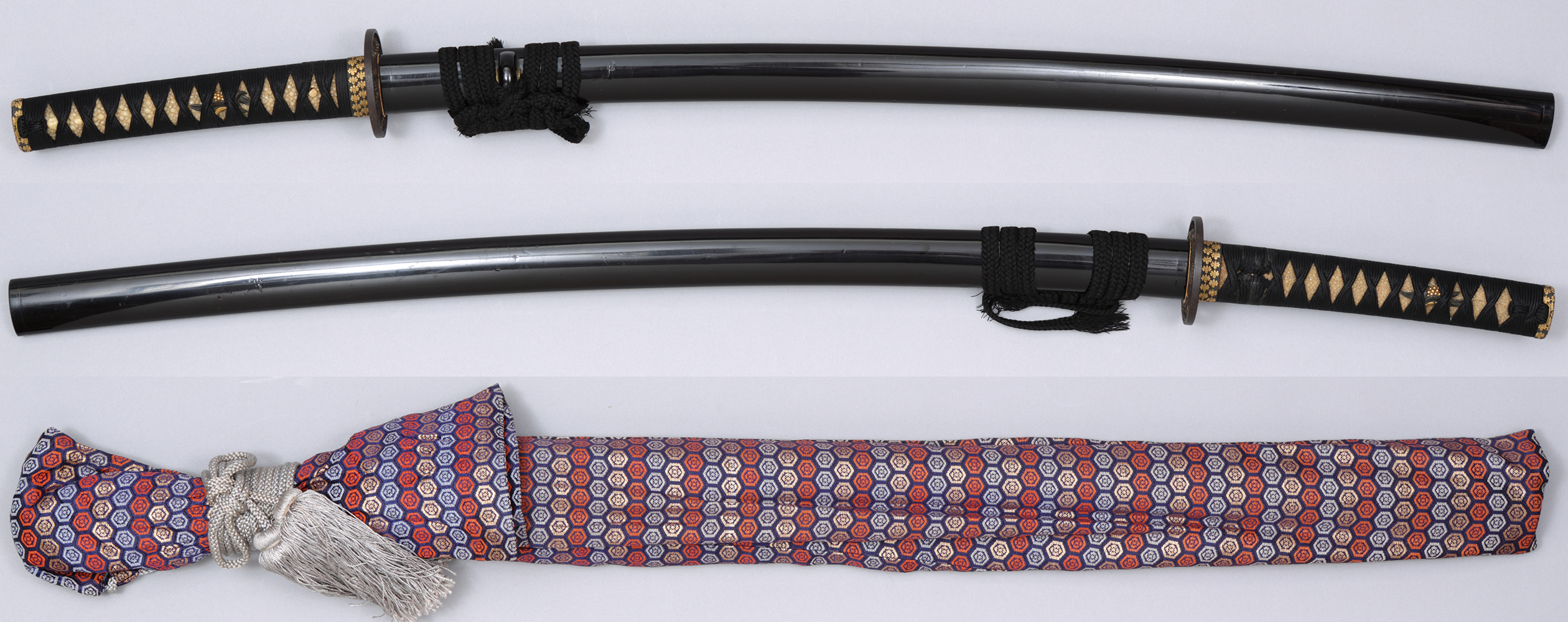
大刀 拵
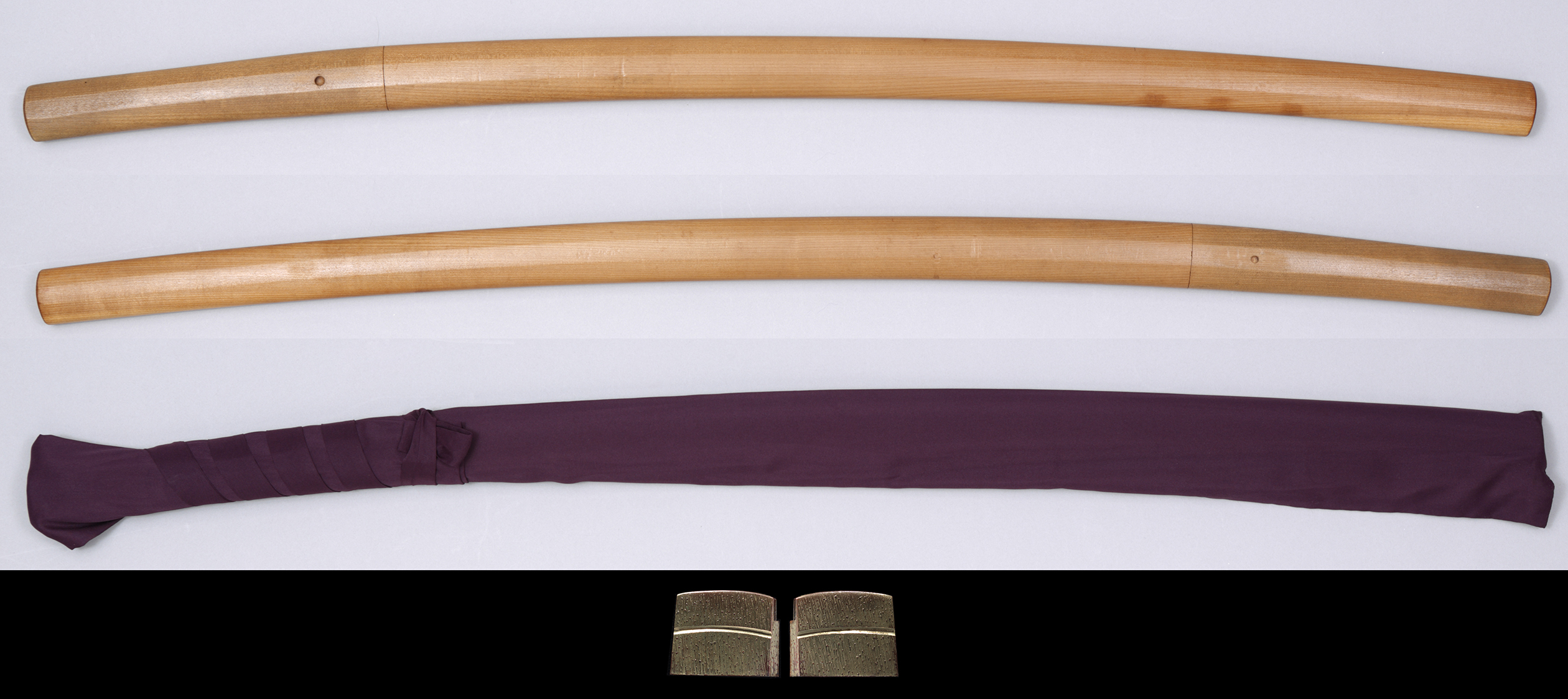
大刀 白鞘
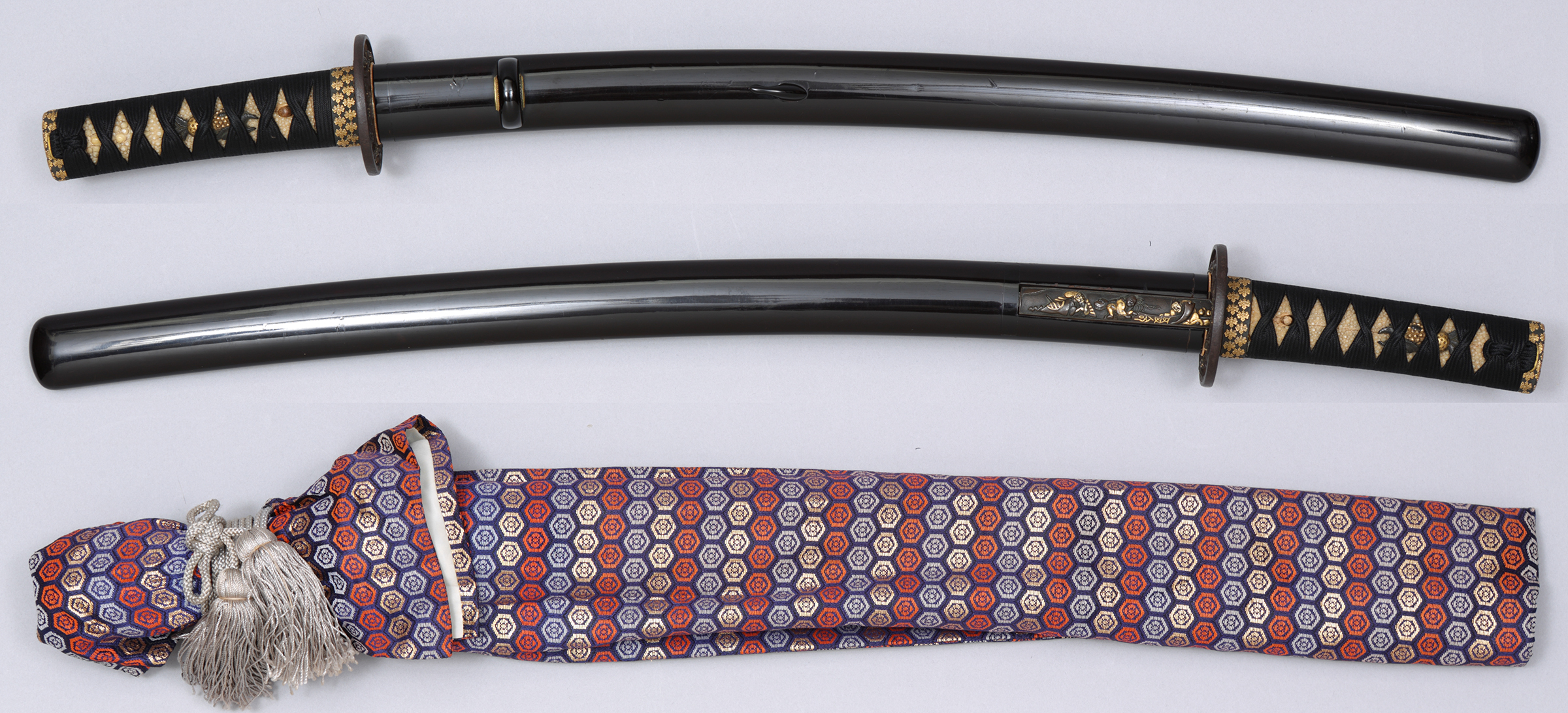
脇差 拵
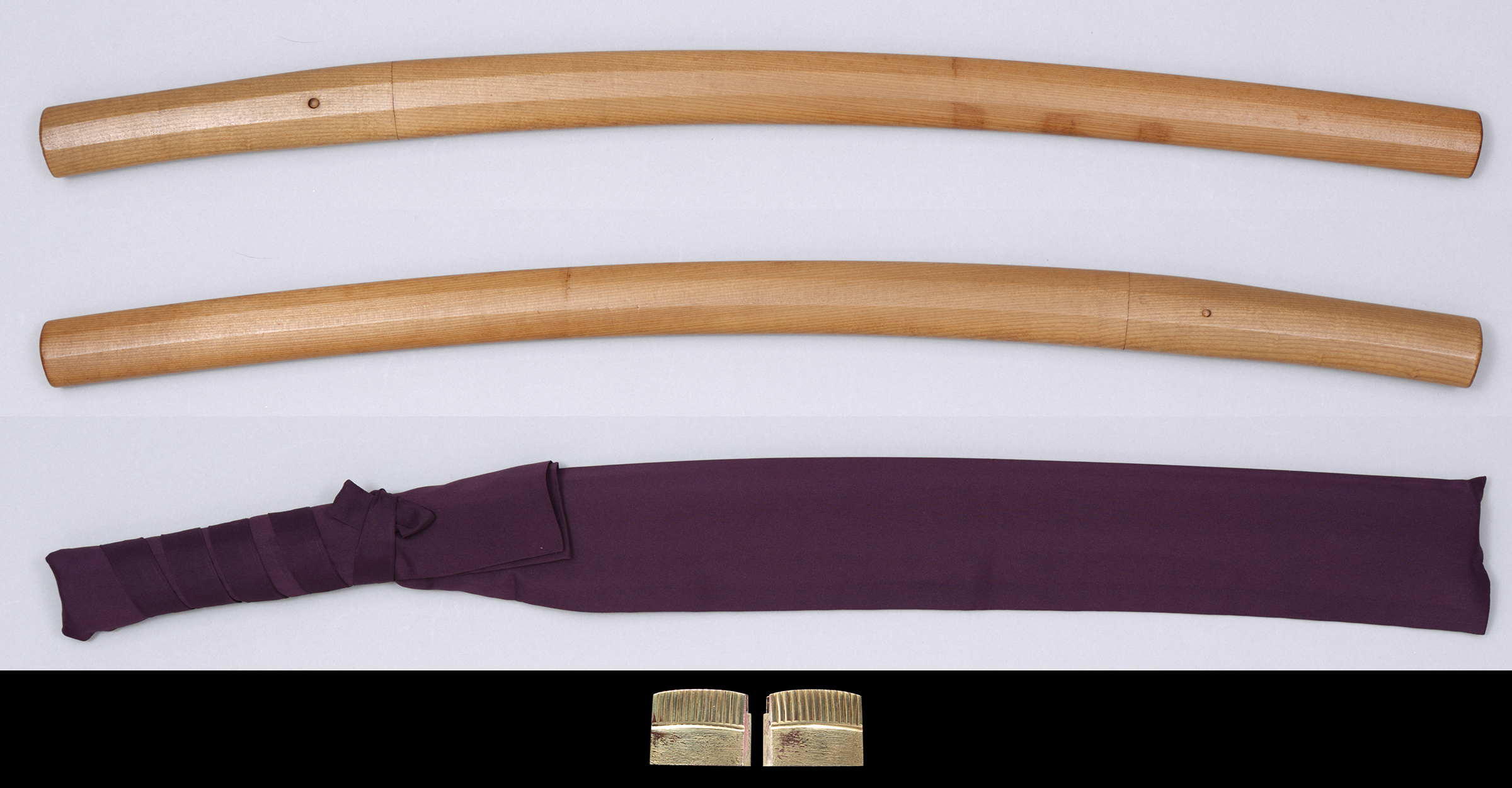
脇差 白鞘
Daisho, Shirasaya, Koshirae
Hojoji Masahiro, Bungo takada Yukimitsu
[ Signature ] omote : 近江守法城寺橘正弘 ura : - ura : 豊後高田住藤原行光 ura : -
[ Size ] 
Dai Long: Blade length 71.20 cm (2 shaku 3 sun 5 bu 0 rin), Curvature 1.21 cm (4 bu 5 rin), Base width 3.22 cm, Base thickness 0.67 cm, Tip width 2.12 cm, Tip thickness 0.45 cm, 2 mekugi holes, Blade weight 724g, total length of shira-saya 100cm, total length of outfit 98cm
Sho Short: Blade length 52.87 cm (1 shaku 7 sun 4 bu 5 rin), Curvature 1.51 cm (5 bu 0 rin), Base width 3.06 cm, Base thickness 0.68 cm, Tip width 2.05 cm, Tip thickness 0.47 cm, Mekugi hole 1, Blade weight: 525g, total length of shira-saya: 75.3cm, total length of outfit: 73cm
[ Period ] Edo (both dai-sho)
[ Province ] Dai : Musashi, sho : Bungo
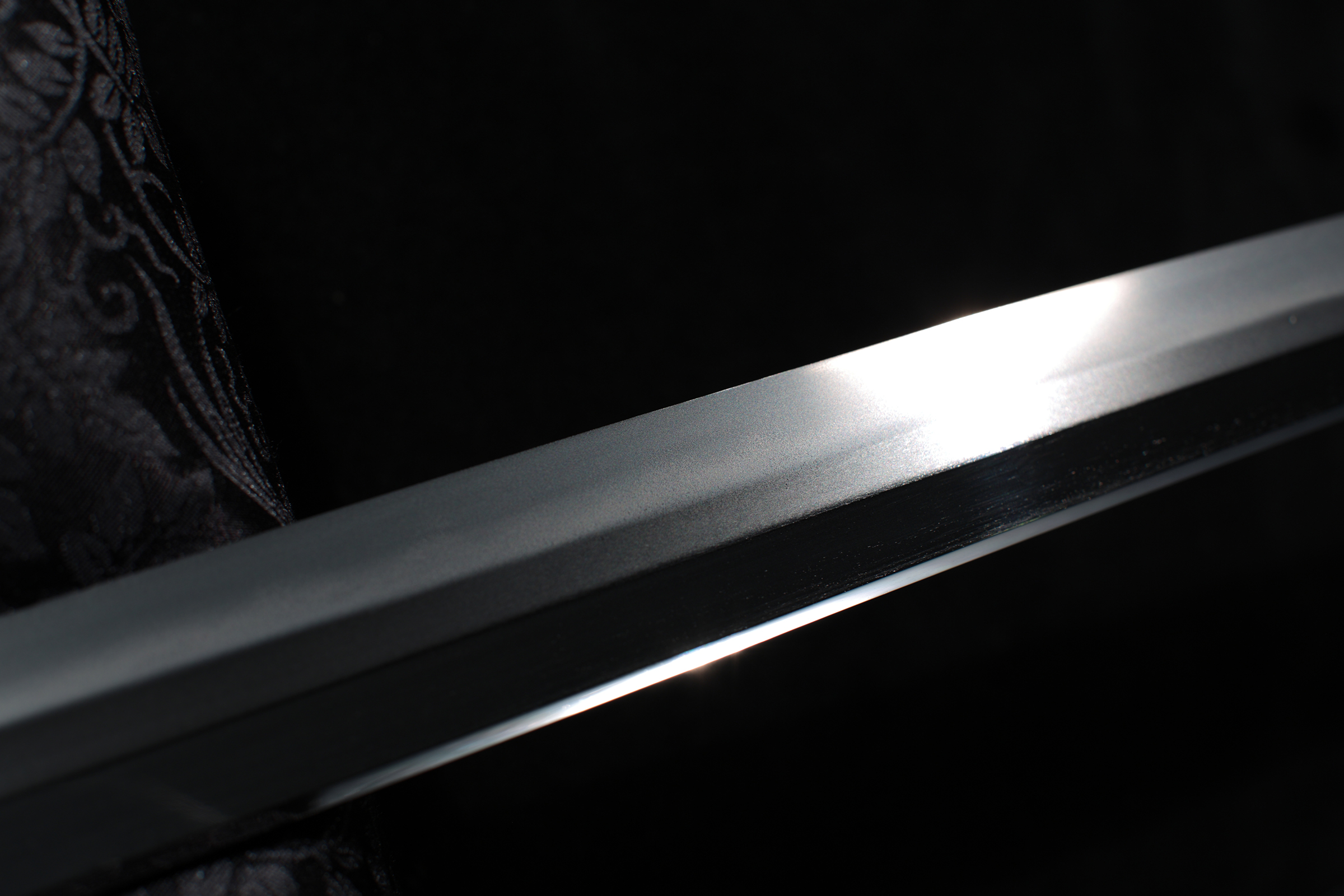
大刀 部分拡大
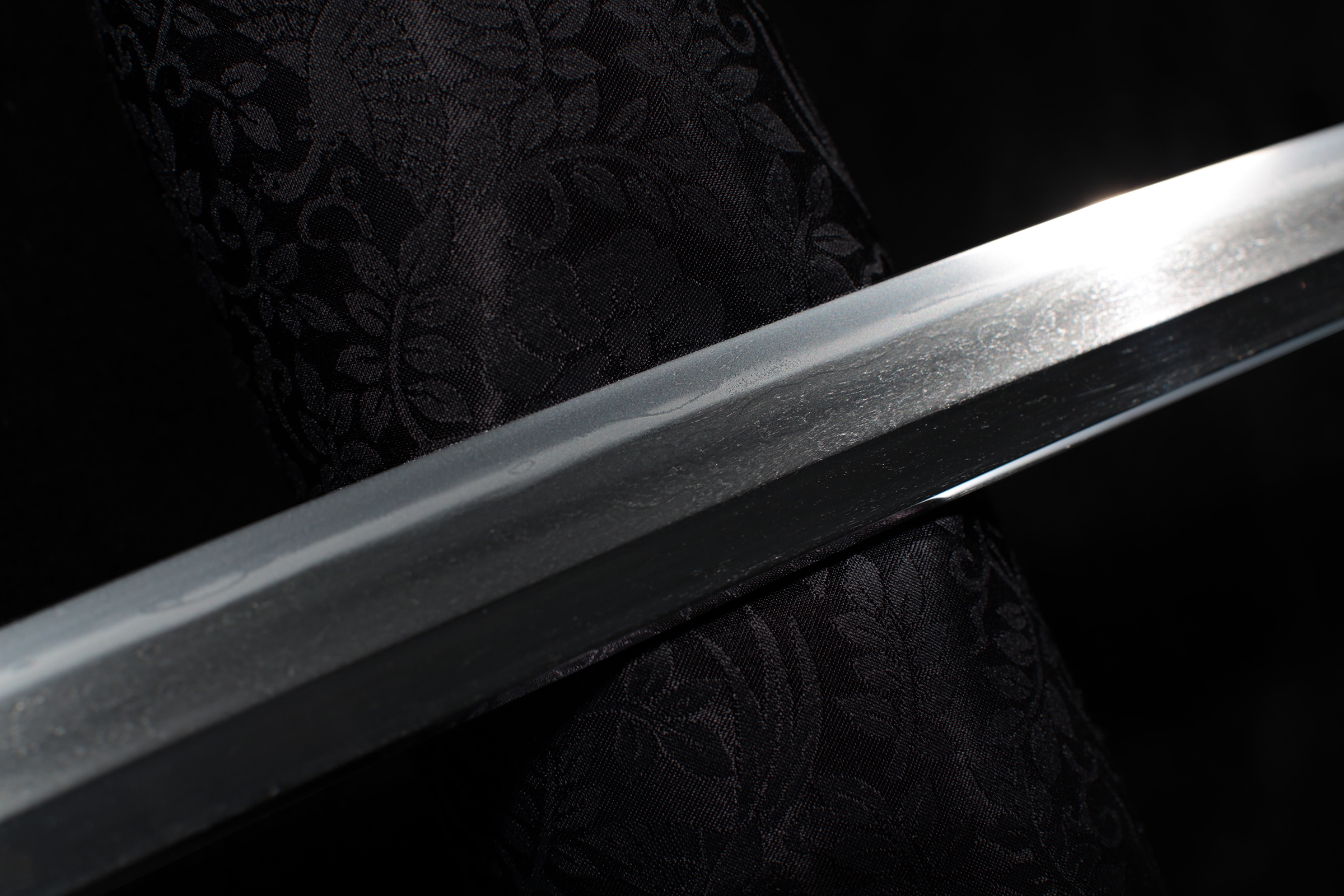
脇差 部分拡大

[ Feature ]
Dai :
Form : The blade features a shinogi-zukuri temper line, an iori-mune profile, a broad body, a moderate thickness, a shallow curvature, a slight difference in width between the base and the tip, and a medium cutting edge.


Nakago : The tang is raw, with irregular file marks; the tip is curved at the tips; there are two mekugi holes, slightly offset.
Jigane : The jigane exhibits a fine-grained, layered itame-hada texture with a distinct ji-nie.
Hamon : The hamon is a broad, straight edge with a shallow curve, mixed with gunome mutual-eye patterns; it has a deep nihoi, well-defined ji-nie, and sunagashi patterns.
Boushi : The habaki returns straight to a small round shape and sweeps outwards at the tip.

[ Highlight ]Omi-no-kami Masahiro was a swordsmith of the early Edo period and the head of the Edo Hōjōji school. Originally from Tanba, he was known as Takigawa Saburōdayū, and around the time of the Hōei era, he created swords in Satsuma and Mito. 

There are two generations of this signature, both of whom held the title of Omi-no-kami; the first generation has inscriptions dating to the Jōō, Manji and Kanbun eras, whilst the second generation has inscriptions from the Enpō and Genroku eras. Based on the characteristics of the signature, this piece is judged to be the work of the second generation.

[ Conditions ] Polished, excellent.

[ Feature ]
Sho :
Form : Shinogi-zukuri, with an iori-mune ridge; of ordinary width, with a slightly thick layer of grain; moderate curvature, resulting in a medium cutting edge.
Nakago : Raw tang, with irregular file marks; the tip rises slightly, ending in a chestnut-shaped butt; one mekugi hole.
Jigane : The jigane has an itame-hada texture, with a moderate grain structure; it exhibits ji-nie and chi-kei.
Hamon : The hamon is a medium-straight hamon, with deep nihoi, well-defined nie, and streaks of kin-suji and sunagashi.
Boushi : The boushi curves straight back into a small round shape.

[ Highlight ] Bungo Takada Yukimitsu was a swordsmith of the early Edo period. He inscribed his blades with names such as ‘Bungo Takada-ju Fujiwara Yukimitsu’,‘Fujiwara Yukimitsu of Bungo’, ‘Fujiwara Yukimitsu of Bungo’, and ‘Yukimitsu, Kanazaemon-no-jo of Nakama, residing in Bungo Takada’. Works with signatures include those from the fourth year of Jōō and the second year of Manji.

[ Conditions ] Polished, excellent.

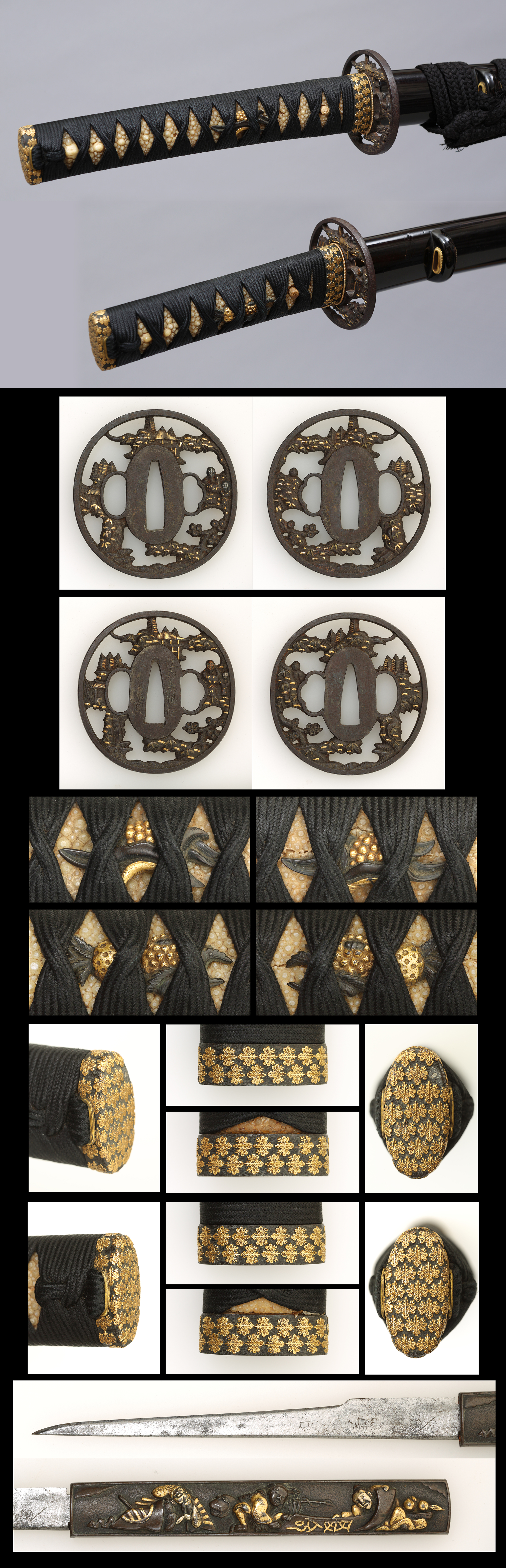
This is a pair of a large and small arrangement of sheathes in the early Edo period style, featuring a straight-edged pattern with deep niō and fine ni. They are presented as a set, complete with a large and small arrangement of sheathes made during the Edo period.

Black lacquered sheath, large and small arrangement: Five-and-three paulownia leaf scattered pattern; fuchigashira (red copper ground with fish-scale texture, gold coloured painting), waterfall scene; openwork sword guard (iron jigane, signature ‘Sōten of Hikone, Ōmi Province’), floral design menuki (red copper ground, relief carving, gold coloured painting); Three Lucky Gods design kozuka (red copper ground, gold coloured painting) (Small set only)

There are traces of repair to the handle cord near the mekugi hole on the back of the large sheath’s handle.

[ Attachments ]
Dai : habaki (suaka-ji, gold iroe, single), shirasaya, bag of shirasaya, koshirae, bag of koshirae and NBTHK tokubetsu kicho paper (issued on 13th Sep. Showa 34(1959)).
Sho : habaki (suaka-ji, gold iroe, single), shirasaya, bag of shirasaya, koshirae, bag of koshirae and NBTHK tokubetsu kicho paper (issued on 23rd Oct. Howa 46(1971)).
大刀 拡大画像
脇差 拡大画像
拵詳細画像


[ Item number ] A071225 [ Price ] JPY 2,000,000- (shipping and insurance fee are not included in the price)

Please order by
E-mail.


About TOUKEN KOMACHI

BACK

TEL +81-(0)3-5284-9014/ FAX +81-(0)3-5284-9043____E-mail : s_tsukada@toukenkomachi.com

Copyright © 2009- Touken komachi All rights reserved.