[ Feature ]
Form : A shinogi-zukuri blade with an iori-mune profile, of ordinary width and thickness, exhibiting a slight difference in width between the base and tip, with a shallow curvature forming a medium cutting edge.
Nakago : The tang is raw, with a diagonal file pattern finished with a cosmetic file, a yamagata-shaped tip, and one mekugi hole.
Jigane : The jigane (base metal) shows an itame-hada pattern with a slight masa-grained appearance, exhibiting ji-nie (fine grain), chi-kei (fine lines), and a white-like appearance.
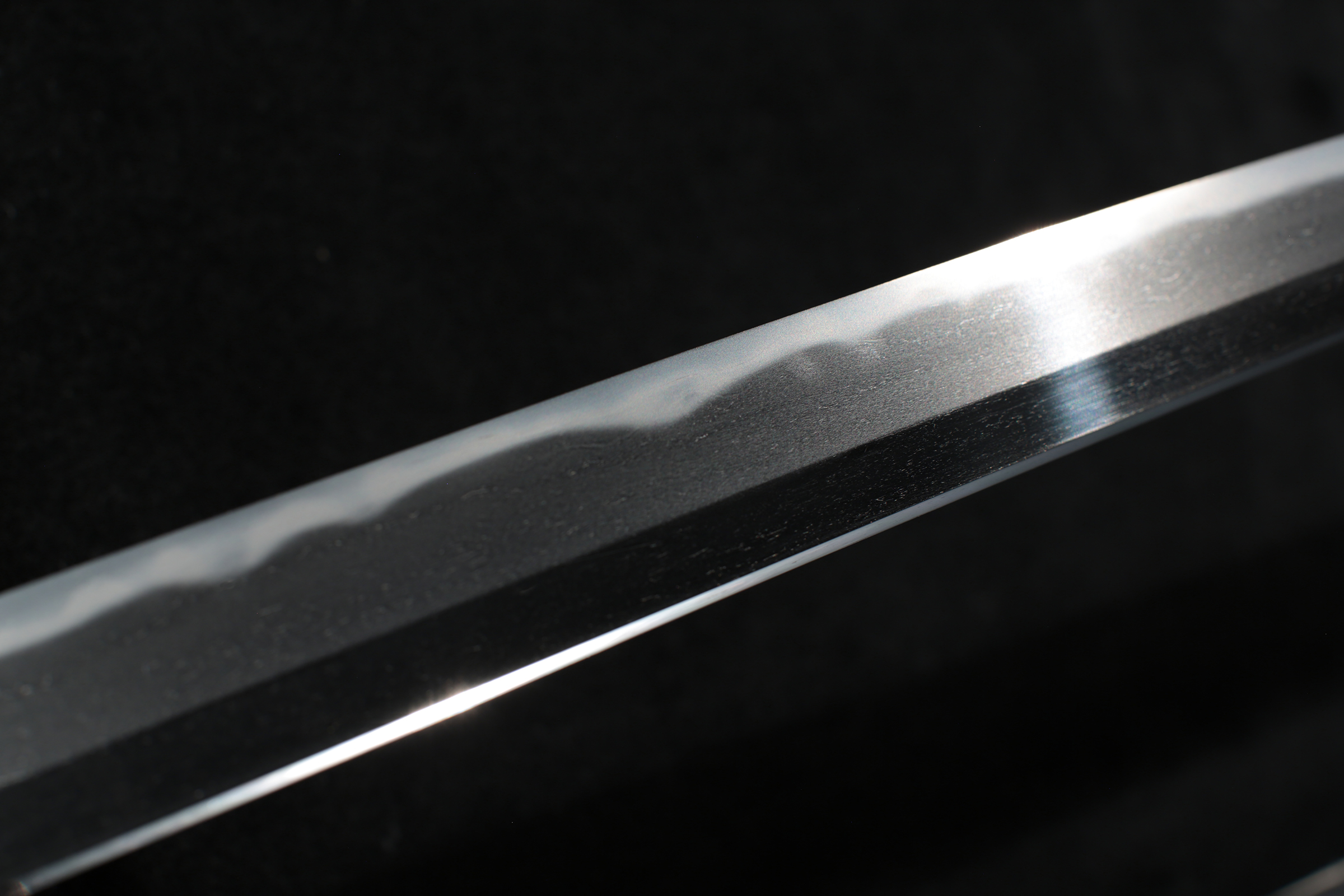
Hamon : The hamon is a wavy blade pattern with a sharp, irregular gu-no-me (interlocking) blade, interspersed with sharp points, featuring foot patterns and occasional nie (blossom) patterns, with sunagashi.
Boushi : The boshi (temper line of top part)is irregularly drawn, small and rounded, with the tip slightly swept.
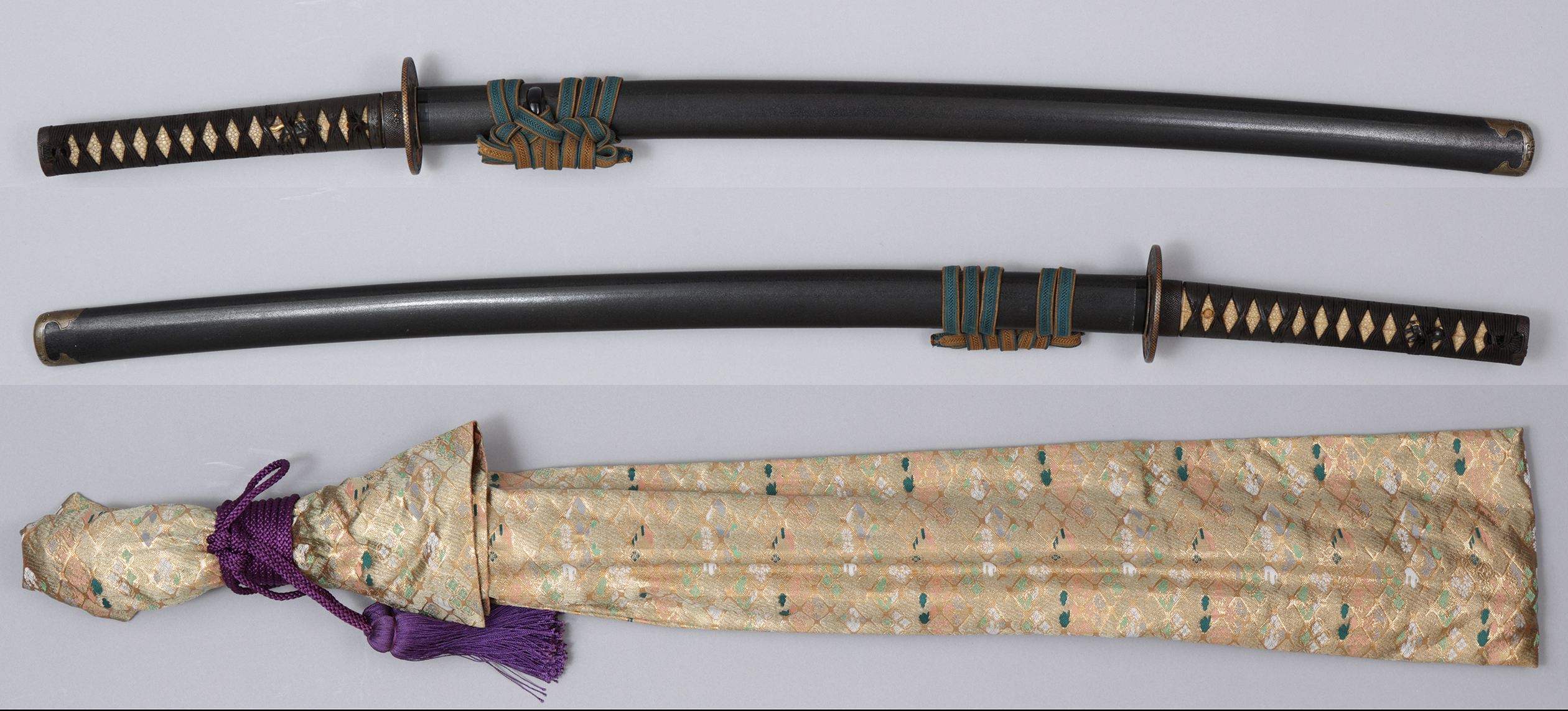
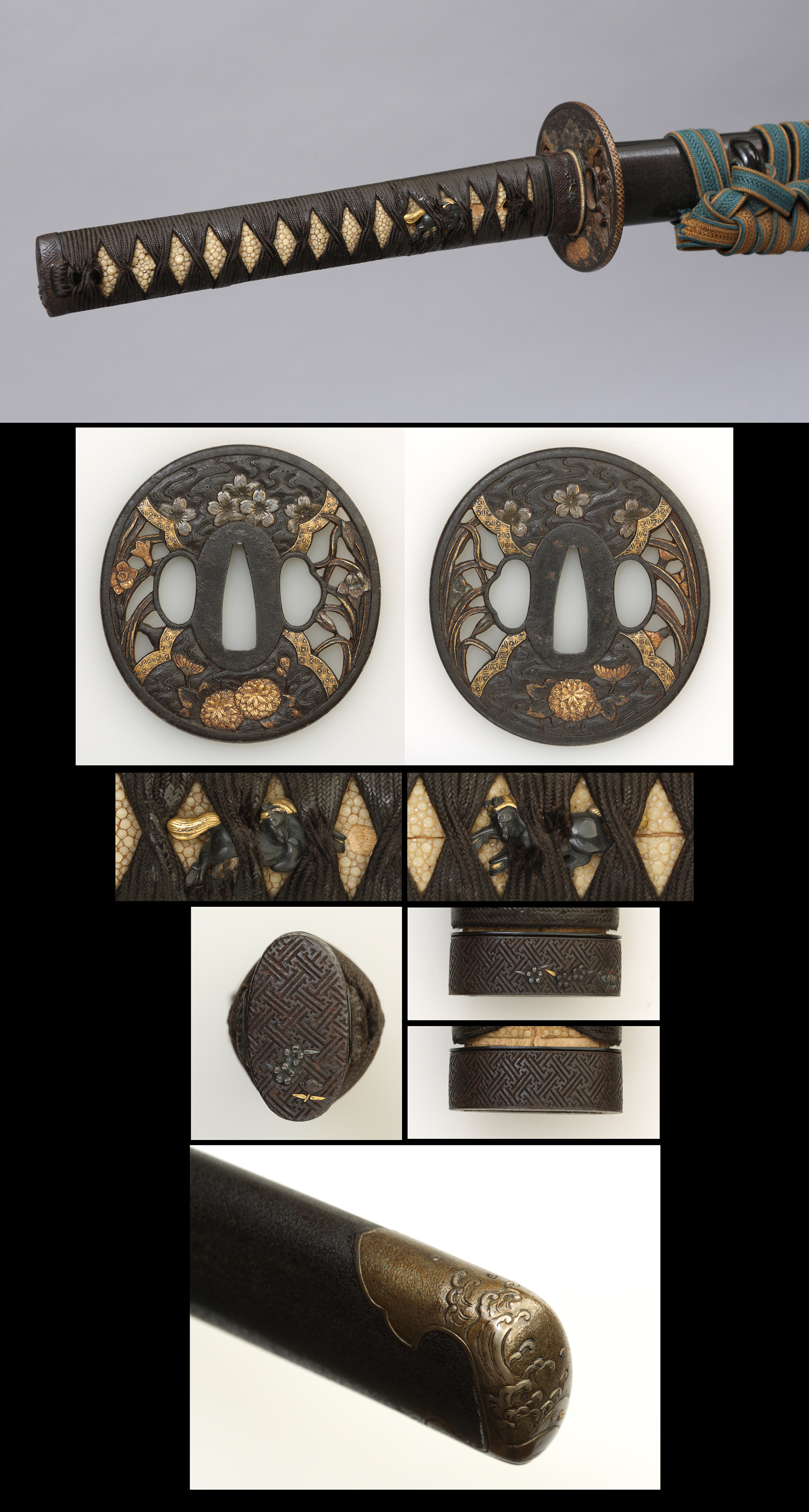
Kuroishi-me-nuri sword guard for uchigatana: Sword guard with design of waves, chrysanthemums, cherry blossoms, orchids and irises (iron ground with inlaid colour painting), menuki with design of horses (shakudō with gold coloured painting), fuchi-gashira with floral design on sa-ya pattern ground (iron ground with inlaid colour painting), tsuba with design of waves (copper with stone-grain ground.
黒石目塗鞘打刀拵 : 波菊桜蘭菖蒲図鐔(鉄地象嵌色絵)、馬図目貫(赤銅容彫金色絵)、紗綾形地紋花卉図縁頭(鉄地象嵌色絵)、波濤図鐺(銅石目地)
[ Highlight ] Katsukuni was a Kaga swordsmith who took the moniker Darani. His family name was passed down through generations throughout the Edo period, from the early Edo era to around the Keiō era. This piece is by the second Katsukuni, considered the most skilled among the Katsukuni swordsmiths. The second Katsukuni initially signed his signature as Ieshige. In the first year of Kanbun, he requested the title of Iyo Daijō to Yotsuji Dainagon through Lord Maeda Shuden, and received it. He then changed his previous name, Fujiwara no Ieshige, to Tachibana no Katsukuni. His signatures include: ‘Made by Fujiwara Ieshige of Kaga Province’, ‘Iyo Daijo Tachibana Katsukuni Forged’, ‘Iyo Daijo Tachibana Katsukuni Made’, ‘Tachibana Katsukuni of Kanazawa, Kaga Province’, ‘Iyo Daijo Darani Tachibana Katsukuni’, ‘Iyo Daijo Darani Tachibana Katsukuni of Kaga Province Made’, and ‘Iyo Daijo Tachibana Katsukuni’. Created swords include those from Kanbun 2, 3, 5, 10, and 11. He passed away on the 8th day of the 6th month in Kanbun 12, with his family temple being Kyushōji in Horikawa Kakuba-chō, Kanazawa City. His signature style, known as the ‘three-cedar pattern’ (sanbon-sugi) for new swords (shintō), became so renowned that it was said, ‘If it has the three-cedar pattern, it must be Katsukuni.’ His swords were celebrated for their exceptional cutting ability and were also known as great masterpieces. This piece shows a shallow curvature typical of the Kanbun period. Its jigane displays a slightly coarse, itame grain pattern with a white-like appearance. The hamon features a three-pine-style mutoname with irregularities. From the tip of the blade, shadow-like reflections appear within the jigane, while the valleys of the niō-motoname show沸つき (nie) and sunagashi patterns. This blade pattern offers numerous points of interest, making this an outstanding example of Katsukuni's work.
[ Conditions ] The blade is in excellent condition, with only one small rust spot approximately 3cm above the machi. The sheath is preserved as it was originally made during the Edo period; the handle wrapping shows some fraying, while the lacquered scabbard and metal fittings are in excellent condition.